BLR Terminal 1 vs. Terminal 2: Which One Does Your Airline Use?
Avoid the split-terminal trap at Bangalore Airport. Learn exactly which domestic and international airlines use Terminal 1 versus the award-winning "Garden Terminal" 2. Discover the critical rules for IndiGo’s route splits, the Air India group consolidation, and how BMTC Vayu Vajra airport buses approach each terminal drop-off point.
Nanda Kishore
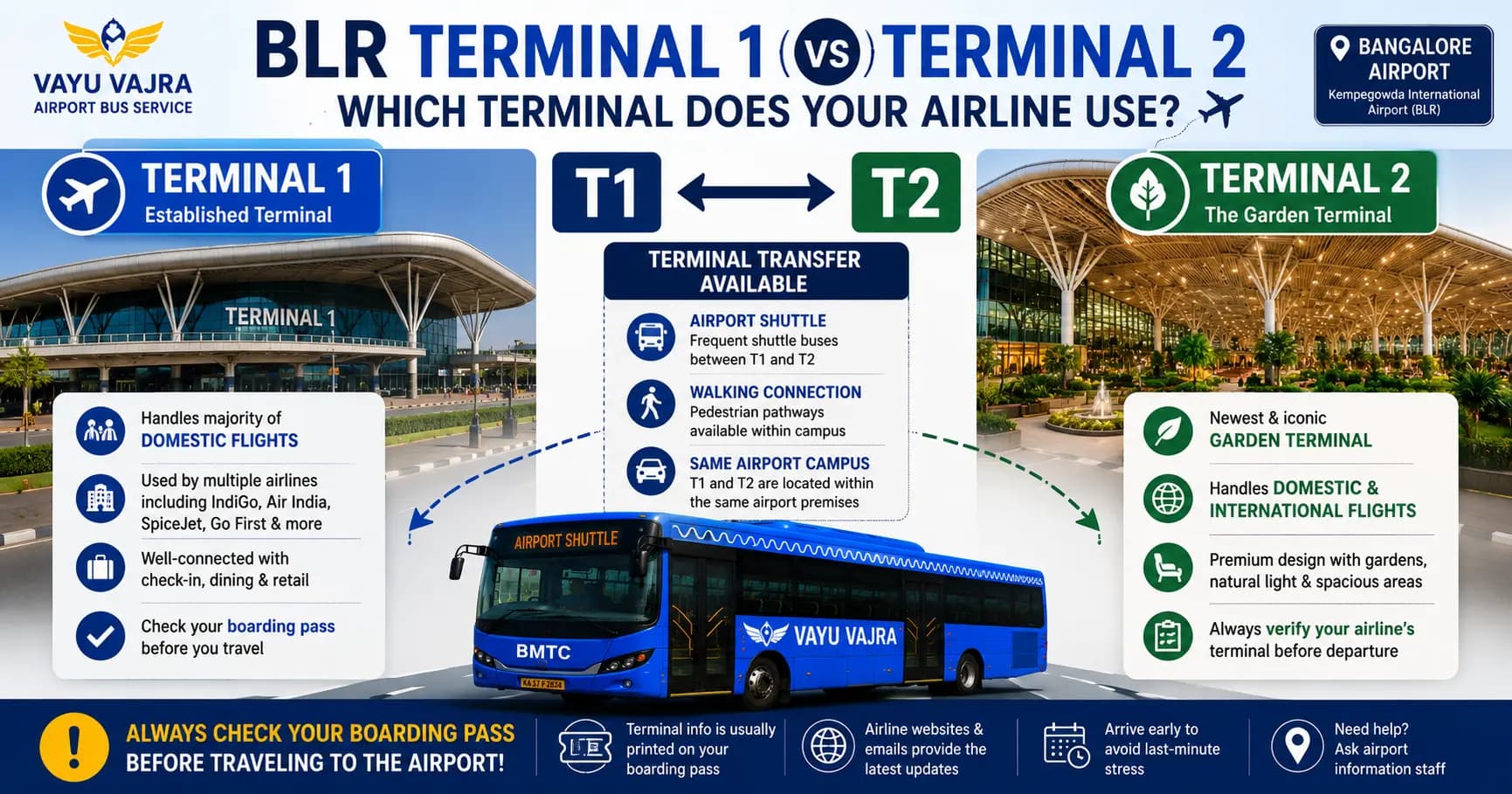
Avoid missing your flight at Kempegowda International Airport. Check the complete 2026 airline terminal matrix for BLR Terminal 1 and Terminal 2, including the critical IndiGo and Air India split rules.
Navigating Kempegowda International Airport (BLR) in Bangalore has transformed into one of the most advanced aviation experiences in South Asia. Following the full operational integration of the architectural masterpiece that is Terminal 2 (T2)—the world-renowned "Terminal in a Garden"—the physical layout of the airport has fundamentally shifted. For travelers, this expansion brings immense capacity and luxury, but it also introduces a serious logistical point of failure: airline terminal split allocations.
Terminal 1 (T1) and Terminal 2 (T2) are distinct physical complexes situated within the same sprawling Devanahalli airport campus. Arriving at the wrong terminal can cause immense anxiety, long delays, or a completely missed flight. This comprehensive, quality-checked 2026 guide maps out exactly which terminal your airline uses, details critical split-terminal carrier rules, and explains how to navigate the airport campus effortlessly.
💡 Quick Answer: The BLR Terminal Baseline Rule
Transferring between Terminal 1 and Terminal 2 at Bangalore Airport is best achieved by utilizing the complimentary, 24/7 inter-terminal shuttle buses provided directly by the airport authorities. As a universal rule of thumb at BLR Airport:
Terminal 1 (T1) serves the majority of domestic low-cost budget carriers (such as select IndiGo domestic flights, Akasa Air, and SpiceJet).
Terminal 2 (T2) handles 100% of international flights across all airlines without exception, alongside premium domestic carriers (Air India, Air India Express, and Star Air).
The most critical exception to this baseline is IndiGo, which splits its massive flight volume across both terminals depending entirely on whether your specific route path is domestic or international.
1. Key Airport Facts and Terminal Technical Specifications
Understanding the baseline infrastructure of Kempegowda International Airport helps eliminate confusion before your journey begins.
Feature / Detail | Terminal 1 (T1) Specifications | Terminal 2 (T2) Specifications |
Official Airport Name | Kempegowda International Airport (BLR), Devanahalli | Kempegowda International Airport (BLR), Devanahalli |
Inauguration / Age | Opened in May 2008; trusted original facility | Opened in November 2023; modern expansion |
Architectural Theme | Functional, conventional, industrial-grade layout | "Terminal in a Garden" by Skidmore, Owings & Merrill (SOM) |
Primary Operations | Select Domestic Budget Airlines Only | 100% International Operations + Premium Domestic |
Check-in Technology | Traditional counters & self check-in kiosks | Biometric screening (DigiYatra), automated kiosks |
Inter-Terminal Connection | Linked via complimentary 24/7 low-floor shuttle | Linked via complimentary 24/7 low-floor shuttle |
Transfer Time & Cost | 5 to 7 minutes road transit time; 100% Free | 5 to 7 minutes road transit time; 100% Free |
Vayu Vajra Bus Drop-off | Dedicated T1 Ground Bus Lanes | Dedicated T2 Ground Transportation Center |
2. Terminal 1 (T1): Physical Infrastructure and Scope
Terminal 1 remains the bedrock of Bengaluru’s aviation expansion, having served as the primary entry point to the city since 2008.
Layout and Operational Focus
T1 features a highly functional, compact layout designed for rapid passenger processing. It consists of a multi-level structure where passengers can easily navigate from the check-in counters located in the main hall directly through security checkpoint lanes to the departure gates.
As of 2026, Terminal 1 has transitioned into a domestic-only terminal. It handles the dense volume of regional short-haul vectors and domestic budget flights across India. No international departures or arrivals touch T1 infrastructure.
Key Passenger Facilities
Check-In & Security: The departure hall is equipped with physical airline desks along with an array of standalone self check-in kiosks to reduce wait times.
F&B and Retail: T1 hosts classic Bengaluru airport staple restaurants, cafes, fast-food outlets, and convenience shopping layouts located both landside and airside.
Ground Access: The BMTC Vayu Vajra bus bay sits directly outside the arrivals gate exit walkway, offering quick city transit integration.
3. Terminal 2 (T2): The Premium Experience
Terminal 2 is an architectural masterpiece designed by the renowned firm Skidmore, Owings & Merrill (SOM) to mirror Bengaluru’s historical reputation as India’s "Garden City". Widely recognized as one of India's largest and most visually striking terminals by total floor area, T2 incorporates massive indoor gardens, multi-level waterfalls, natural light-maximizing atriums, and extensive woven bamboo structures to offer a high-end, premium atmosphere.
Operational Scope & Advanced Facilities
Terminal 2 is the exclusive home for all international flights arriving or departing from Bangalore. In addition, it completely accommodates specific domestic carriers that have fully integrated their networks within T2.
Biometric Smart Security: T2 emphasizes digital-first passenger processing, heavily implementing biometric facial recognition gates (DigiYatra infrastructure) alongside automated baggage screening lanes.
Premium Lounges: World-class luxury lounges are accessible to business-class passengers and eligible credit cardholders, offering premium dining and relaxation suites.
Expanded Retail Plaza: The airside zone operates an expansive duty-free shopping complex alongside luxury international brands and fine dining establishments.
4. Master Airline Allocation Matrix
To completely eliminate the risk of arriving at the wrong terminal, utilize this programmatic airline terminal distribution matrix before finalizing your airport transit.
Domestic Airline Allocations
Airline | Terminal Assignment | Critical Operational Notes |
IndiGo (Domestic) | Terminal 1 (T1) (Select Routes) | Major Exception: Check tickets closely. Most domestic IndiGo routes use T1, but all international flights leave from T2. Heavy domestic connecting slots can occasionally change based on seasonal capacity. |
Akasa Air | Terminal 1 (T1) | Handles its primary domestic footprint out of T1. |
SpiceJet | Terminal 1 (T1) | All active domestic departures and arrivals process through T1. |
Alliance Air | Terminal 1 (T1) | Regional turboprop flight vectors utilize T1 infrastructure. |
FLY91 | Terminal 1 (T1) | Regional short-haul carrier operating entirely out of T1. |
Air India (Domestic) | Terminal 2 (T2) | Fully consolidated at T2. Do not go to T1 for domestic Air India flights. |
Air India Express | Terminal 2 (T2) | Fully integrated into T2 alongside its mainline parent company. |
Vistara | Terminal 2 (T2) | Post-merger operations are entirely synchronized and branded under Air India within the T2 complex. |
Star Air | Terminal 2 (T2) | Premium regional and domestic routes process exclusively at T2. |
International Airline Allocations
⚠️ The 100% Rule: Every foreign legacy airline and international destination departure operates out of Terminal 2. There are zero international commercial processing facilities left inside T1.
Emirates (To Dubai) ➔ Terminal 2 (T2)
Singapore Airlines (To Singapore) ➔ Terminal 2 (T2)
Qatar Airways (To Doha) ➔ Terminal 2 (T2)
Lufthansa (To Frankfurt) ➔ Terminal 2 (T2)
British Airways (To London Heathrow) ➔ Terminal 2 (T2)
Air France / KLM ➔ Terminal 2 (T2)
Cathay Pacific (To Hong Kong) ➔ Terminal 2 (T2)
Etihad Airways (To Abu Dhabi) ➔ Terminal 2 (T2)
Malaysia Airlines (To Kuala Lumpur) ➔ Terminal 2 (T2)
Thai Airways (To Bangkok) ➔ Terminal 2 (T2)
Scoot (To Singapore) ➔ Terminal 2 (T2)
Oman Air ➔ Terminal 2 (T2)
IndiGo (International Only) ➔ Terminal 2 (T2)
Air India (International Only) ➔ Terminal 2 (T2)
5. Deep Dive: The Critical "Airline Gotchas"
Certain carrier layouts across Bengaluru's airport ecosystem present complex operational anomalies that frequently cause passenger confusion. Pay close attention to these two primary rules:
The IndiGo Terminal Split
Because IndiGo handles the single largest market share of domestic passenger volume in Bangalore, the airline cannot fit its entire fleet allocation inside T1.
The Route Logic: If you are traveling domestic (e.g., to Mumbai, Delhi, or Hyderabad), your flight will almost certainly proceed out of Terminal 1. However, if you are boarding an international IndiGo flight (e.g., to Singapore or Dubai), your route is classified as international and you must go strictly to Terminal 2.
The Connecting Flight Trap: If you have booked a single ticket connecting from a domestic segment to an international segment via BLR (e.g., a heavy domestic flight path from Amritsar or Hubli to Bangalore before a connection to Dubai or Bangkok), your aircraft will land at T1. You must deplane, retrieve your baggage (if not through-checked), and manually transit across to T2 to pass through international customs and immigration. Because a handful of domestic connecting flights can occasionally change slots based on seasonal capacity, perform a rigorous e-ticket check before leaving home.
The Air India Group Consolidation
Unlike IndiGo's route-split layout, the Air India ecosystem is strictly organized by corporate brand location. Following the completion of the Air India-Vistara merger, the entire group operations are centralized.
Unified T2 Infrastructure: Every single flight operated by Air India, Air India Express, or former Vistara assets departs from Terminal 2. Do not allow taxi or rideshare drivers to mistakenly drop you off at T1 simply because you mention you are taking a domestic leg on Air India.
6. How Terminal Allocations Affect Your Bus Drop-Off
For commuters using the extensive BMTC Vayu Vajra (KIA-series) airport bus network, terminal knowledge alters your arrival timeline.
[City Boarding] ➔ [Approaching BLR Campus] ➔ [Bus Stops at T1 Ground Bay] ➔ [Bus Stops at T2 GTC]