Bangalore Airport Travel During Monsoon: What to Expect
Planning a trip to BLR Airport during Bengaluru's rainy season? Discover why the Vayu Vajra bus beats cabs during a downpour, see corridor-by-corridor monsoon transit times, and learn how to calculate your perfect stress-free travel buffer.
Nanda Kishore
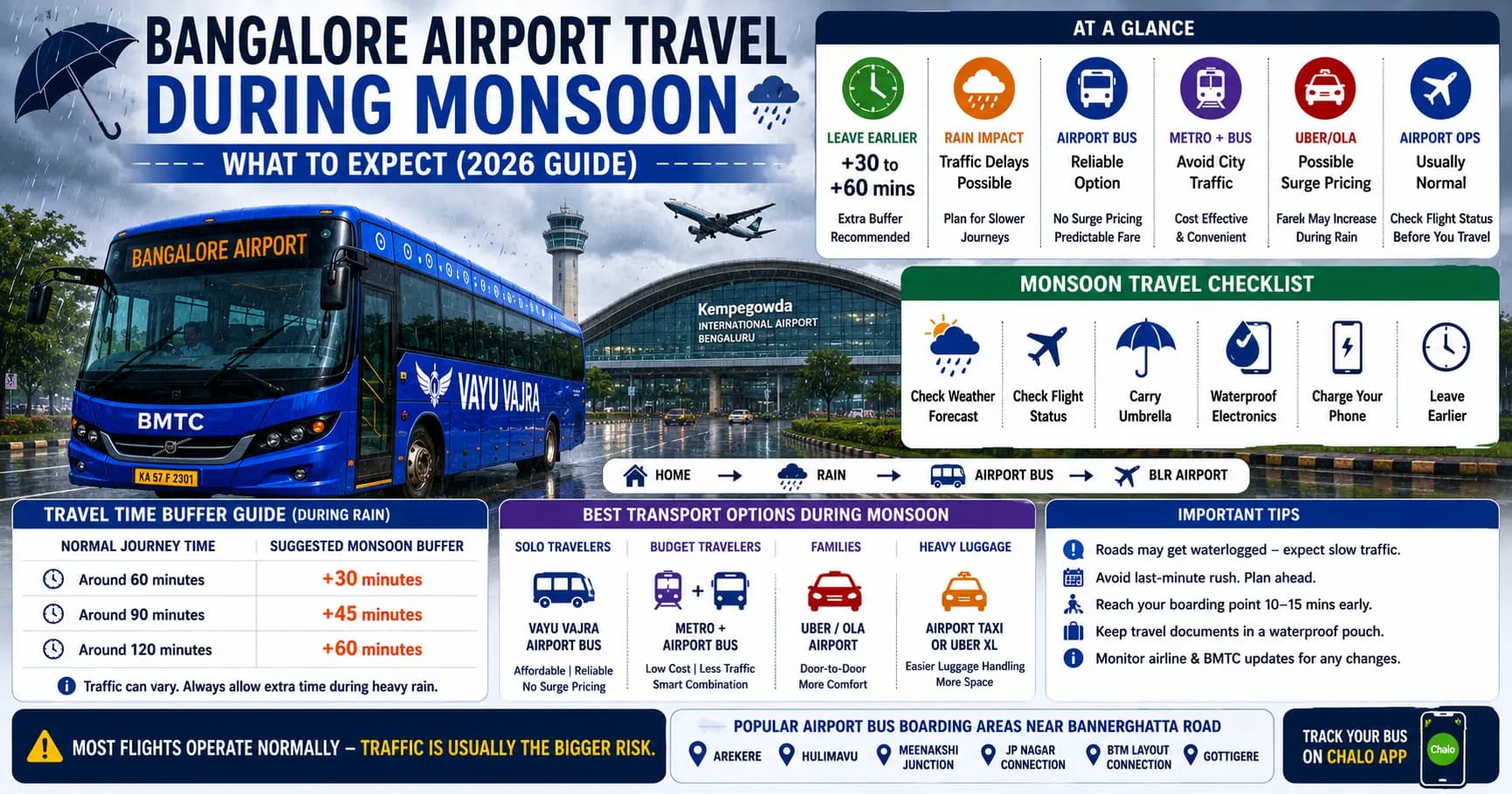
The arrival of the monsoon season in Bengaluru brings a welcome drop in temperature, transforming the city's famous parks and tree-lined avenues into lush, green landscapes. However, for air travelers heading to or from Kempegowda International Airport (BLR), the rainy season also introduces a unique set of transit challenges.
Because the airport is located in Devanahalli—roughly 40 to 65 kilometers north of the city center—a trip to the terminal becomes highly variable the moment a heavy downpour begins. Heavy rain can cause rapid localized waterlogging, slow road traffic to a crawl on major corridors, and create severe cascading flight delays. Hailing a private app-based taxi during a storm routinely traps commuters in booking loops, excessive surge rates, and flooded highway lanes.
To navigate the rainy season like a pro, you need to understand what to expect on the roads, how flight operations shift during a storm, and how to utilize the city’s transit network as a shield against gridlock. This comprehensive guide provides a complete, stress-free blueprint for your monsoon airport journey.
💡 Quick Answer: The Monsoon Travel Strategy
Traveling to Bangalore Airport during the monsoon is highly manageable, but commuters must expand their standard travel buffer by an explicit 60 to 90 minutes due to severe road waterlogging along the Hebbal Flyover and Outer Ring Road (ORR) corridors. While severe evening thunderstorms can trigger flight delays, your ground transit is the biggest variable. To insulate your journey from rain-induced taxi cancellations and extreme surge pricing, the most reliable strategy is boarding the BMTC Vayu Vajra AC Volvo buses, which utilize high-speed elevated express lanes to bypass street-level flooding. Always verify live schedules on the official BMTC partner app (Chalo App / Namma BMTC) on the morning of your travel and carry at least ₹300–400 in physical cash as a backup.
Key Facts: BLR Monsoon Travel Checklist
Operational Factor | Rain Impact & Ground Reality | Strategic Commuter Action |
Primary Monsoon Window | Southwest Monsoon (Typically June–Sept: Heavier) & Northeast Monsoon (Typically Oct–Nov: Shorter, intense) | Plan for seasonal disruptions across both windows; use "typically" framing for dates. |
Primary Highway Bottlenecks | Hebbal Flyover approach, Outer Ring Road (ORR) intercepts, Silk Board, and Nagawara | Add a strict 30-to-45-minute buffer specifically for these corridor segments. |
Air Traffic Disruptions | Reduced runway visibility and heavy wind shear leading to departure delays or diversions | Book early morning flights (05:00 AM – 09:00 AM) when convective storms are rarest. |
Bus Fleet Reliability | Vayu Vajra buses operate throughout the monsoon with 100% municipal schedule immunity | Prioritize the bus over app-based cabs to guarantee no cancellations or surge pricing. |
Taxi Availability & Cost | High driver cancellation loops and algorithmic surge pricing (1.5x to 3x base fares) | Avoid relying solely on on-demand apps; use buses or pre-booked traditional radio cabs. |
Digital Infrastructure | Localized cellular network tower outages causing UPI payment time-outs onboard | Maintain a minimum of ₹300 to ₹400 in physical cash change inside your wallet. |
Metro Connections | Safe, grade-separated transport completely shielded from street-level flooding | Use Namma Metro Purple/Green lines to reach primary airport bus bays and cut traffic. |
When Is Bengaluru's Monsoon Season?
Understanding the weather pattern is essential, especially for out-of-state and international travelers who might not be familiar with the local climate. Bengaluru is unique because it receives rainfall from two distinct weather systems:
The Southwest Monsoon (Typically June to September): This is the primary and heavier monsoon season. It brings sustained, frequent rainfall, with the heaviest downpours historically concentrated in July and August.
The Northeast Monsoon (Typically October to November): This secondary season is shorter but can produce highly intense, localized evening showers that catch travelers off guard.
Additionally, the pre-monsoon period in April and May frequently brings sudden, violent evening thunderstorms. While the city averages approximately 900mm of annual rainfall, climate patterns have shifted in recent years. Rainfall intensity can vary significantly from day to day—some days experience brief, pleasant showers, while others see prolonged downpours that test the city's infrastructure.
Ground Transit Realities: The Critical Bottleneck Nodes
For most airport travelers, the biggest monsoon challenge is not the airport itself—it is the journey to get there. Bengaluru's drainage network can quickly become overwhelmed during sudden downpours, transforming low-lying service lanes and underpasses into temporary pools of water.
When planning your route to Kempegowda International Airport, you should keep an eye on these historically waterlogging-prone nodes:
1. The Silk Board / Electronic City Corridor (KIA-8)
Silk Board junction is historically one of Bengaluru's most waterlogging-prone intersections. Heavy downpours regularly cause significant flooding that affects both sides of the flyover and service lanes. If you are a KIA-8 passenger traveling from Electronic City, you should expect your standard 110-minute dry run to extend to anywhere between 150 and 180 minutes during active rainfall.
➔ Route Timing Guide: See complete dry-weather intervals in our Airport Bus from Electronic City: Complete 24/7 South Bangalore Grid Guide.
2. The Outer Ring Road (ORR) Tech Corridor (KIA-4, KIA-6, KIA-7, KIA-8)
The ORR is a major transit artery used by several Vayu Vajra routes. Stretches passing through Marathahalli, Bellandur, Mahadevapura, and Nagawara frequently experience extreme gridlock during rainy office hours. Waterlogging along the service lanes forces heavy vehicles and two-wheelers into the central express lanes, dropping average travel speeds down to a crawl. Add at least 30 to 45 minutes to your travel plan if your route touches the ORR during a storm.
➔ Neighborhood Intercepts: Review local boarding stops inside our Koramangala Airport Bus: Complete Guide to Reaching Bangalore Airport.
3. The Hebbal Flyover Junction Loop (KIA-2)
Hebbal is the central funnel where cross-city traffic meets the main airport expressway (NH 44). During heavy downpours, the lower service roads and merging underpass tracks can flood rapidly. This causes vehicles to back up for miles along Bellary Road and the northern corridors. KIA-2 passengers should note that the Bruhat Bengaluru Mahanagara Palike (BBMP) or traffic police may occasionally divert traffic here during extreme weather, which heavily impacts journey times.
4. Dairy Circle & Shanthinagar Bottlenecks
For residents of South Bangalore traveling from areas like Jayanagar, Koramangala, or Bannerghatta Road, the central city exits near Dairy Circle and the Shanthinagar TTMC are highly vulnerable to localized flooding. This clogs northbound arterial routes long before vehicles can reach the open highway lanes.
A Note on Infrastructure: While the locations above have historical reputations for flooding, local authorities continuously work on drainage improvements. Conditions can change year to year, so frame these areas as "frequently reported hotspots" rather than guaranteed obstacles.
🛠️ The Monsoon Time-Buffer Formula
To ensure you comfortably clear airport security lines without panicking, throw away your dry-weather schedule. Calculate your departure timeline during active rainy weeks using this simple backward-mapping formula:
Ideal Departure Time = Target Terminal Entry - Baseline Route Transit Window - Monsoon Traffic Buffer (60-90 Mins)
Domestic Flights: Your target entry at the airport terminal doors should be strictly 2 hours prior to departure.
International Flights: Your target entry at the airport terminal doors should be strictly 3 hours prior to departure.
Real-World Buffer Walkthrough:
If you are traveling from Whitefield for a domestic flight departing at 07:30 PM during an active evening downpour:
Your target terminal entry door time is 05:30 PM.
A standard dry-weather run via the Vayu Vajra bus takes roughly 90 minutes.
Factoring in your 60-to-90-minute monsoon traffic buffer means you should comfortably step onto the bus platform or clear your gates no later than 02:30 PM – 03:00 PM. Leaving any later exposes your timeline to severe highway merging delays.
Monsoon Journey Time Estimates by Corridor
To help you visualize the potential delay patterns, review this corridor-by-corridor breakdown comparing normal transit times to moderate and heavy rain conditions:
Corridor / Main Route | Standard Journey Time | Monsoon Estimate (Moderate Rain) | Monsoon Estimate (Heavy Rain) |
Hebbal / North (KIA-2) | 60 mins | 75–85 mins | 90–110 mins |
Majestic / Central (KIA-9) | 70 mins | 85–95 mins | 100–120 mins |
Indiranagar / East (KIA-4) | 90 mins | 110–120 mins | 130–150 mins |
Koramangala / South (KIA-7) | 100 mins | 120–135 mins | 140–165 mins |
Electronic City (KIA-8) | 110 mins | 135–150 mins | 155–180 mins |
Whitefield / East (KIA-6) | 115 mins | 135–150 mins | 155–180 mins |
Mysore Road / West (KIA-10) | 120 mins | 140–155 mins | 160–190 mins |
Disclaimer: These are planning estimates based on historical monsoon conditions. Actual journey times on the day depend entirely on rainfall intensity and real-time localized waterlogging.
Vayu Vajra Bus vs. Cab: Which Is More Reliable?
When the clouds open up over Bengaluru, private app-based taxis face massive operational liabilities. This is precisely when BMTC’s Vayu Vajra AC Volvo fleet shines as your best defense against gridlock.
[Private App Cabs]                       [BMTC Vayu Vajra Volvos]
├── Prone to 2.5x Surge Spikes           ├── Strict Fixed Distance Tariff
├── Trunk Blocked by CNG Tanks           ├── Clear Underbelly Cargo Holds
└── High Risk of Driver Cancellation     └── 100% Municipal Schedule Immunity
Total Immunity to Surge Inflation: Ride-hailing apps utilize dynamic demand-based algorithms. When rain strands thousands of commuters simultaneously, cab fares routinely skyrocket to 1.5x, 2.5x, or even 3x the base rate. Conversely, Vayu Vajra fares remain completely fixed at their standard distance pricing (ranging from ₹100 to ₹410), providing excellent budget predictability.
Zero Driver Cancellation Loops: A frequent pain point for Bengaluru residents is the dreaded cancellation loop. Private rideshare drivers often reject long-distance airport runs during heavy rain to avoid getting trapped in severe traffic far from their homes. Because government-regulated BMTC drivers operate on fixed rotas and schedules, they run consistently regardless of weather changes.
Heavy-Chassis Safety and Expressway Routing: Volvo multi-axle coaches feature robust chassis structures and high ground clearance, allowing them to navigate minor service lane water accumulation safely. Furthermore, buses heavily utilize the main elevated expressways, completely bypassing the flooded ground-level service tracks.
Professional Driver Expertise: Vayu Vajra operators drive these exact corridors every single day. They know the alternative lanes, understand how the vehicle handles under slick conditions, and maintain calm under pressure.
➔ Price Breakdown: Read our long-term financial analysis on Should I Take a Vayu Vajra Bus or an Uber/Ola Cab?.
When a Cab Might Still Be Preferable
While the bus wins on reliability, a pre-booked taxi or airport cab can be preferable if you are traveling with very young children or elderly family members for whom walking or standing at an uncovered bus stop in active rain is a physical challenge.
Air Operations: Flight Delays, Diversions, & Passenger Rights
The impact of the monsoon isn't restricted to the roads; it can also affect the skies. Heavy cloud formations, low horizontal visibility, and sudden wind shear over the Devanahalli plateau can disrupt flight movements.
Monsoon Aviation Impact Summary: Rising daytime temperatures combine with moisture-laden winds to trigger heavy atmospheric activity by the afternoon and evening. Flights scheduled between 04:30 PM and 10:30 PM experience the highest rate of weather-related ground holdings and arrival delays. * Early morning departures enjoy much clearer, more stable air paths.
Knowing Your Passenger Rights (DGCA Mandates)
If an intense storm hits BLR Airport, resulting in extended ground delays or flight cancellations, the Directorate General of Civil Aviation (DGCA) mandates specific protections for passengers:
Delays Exceeding 2 Hours: The operating airline is legally required to provide complimentary meals, refreshments, and adequate care based on your total wait time.
Delays Exceeding 6 Hours: The airline must offer you the option to either rebook on an alternate flight at no extra cost or receive a 100% full financial refund on your ticket.
Weather Diversions: If your incoming flight is diverted to an alternate airport (like Chennai or Hyderabad) due to severe thunderstorms over Bengaluru, the airline is responsible for refueling and operating the return loop once visibility clears, or arranging alternative onward travel.
Practical Packing Tips for a Monsoon Airport Run
A little extra physical preparation can completely change the quality of your trip:
Carry ₹300–400 in Physical Cash: Heavy monsoon rain and thunderstorms can cause localized cellular tower power outages or disrupt mobile networks. When this happens, onboard dynamic UPI QR code scanning or banking apps can time out unexpectedly. Cash remains the ultimate fallback protocol to pay your bus conductor directly. (Bonus Tip: National Common Mobility Cards run on offline protocols and bypass live network issues entirely ).
Waterproof Document Sleeves or Dry Bags: Protect your passport, boarding pass, laptop, and electronic devices from sudden downpours while walking to or from the bus bay.
Compact Umbrella or Lightweight Rain Jacket: The walk from the designated bus bays to the main terminal doors at BLR involves brief segments exposed to lateral wind and rain. Keep an umbrella easily accessible rather than packed deep inside your checked luggage.
Charged Power Bank: Flight delays or extended road transit mean your phone will consume extra battery on live tracking apps. Keep a fully charged power bank handy.
Use Updated Schedules: Always verify live details on the official BMTC partner app (Chalo App / Namma BMTC) on the morning of your travel rather than relying on the previous night's notes.
Frequently Asked Questions (FAQ)
Q1: Does the airport bus run during heavy monsoon rainfall?
A: Yes, BMTC Vayu Vajra airport buses remain one of the most dependable transportation options during rainy weather and continue running throughout the monsoon season with no weather-specific cancellations. However, journey times can extend by 30 to 90 minutes depending on the corridor and rain intensity, so you must plan accordingly.
Q2: Is Uber or Ola more reliable than the bus during Bengaluru's monsoon?
A: For most travelers, the Vayu Vajra bus is significantly more reliable. Ride-hailing apps experience high driver cancellation rates during heavy rain, and dynamic fare algorithms can spike ticket prices up to 2.5x or 3x the base cost. Buses run on fixed, predictable tariffs and schedules regardless of weather conditions.
Q3: How much earlier should I leave for Bangalore Airport when it rains?
A: It is highly recommended to add an extra 45 to 75 minutes to your standard travel timeline during monsoon months. If your route takes you along the Electronic City, Whitefield, or Outer Ring Road corridors, add at least 75 minutes during active downpours to accommodate major highway merging bottlenecks.
Q4: Which specific route to Bangalore Airport is most affected by monsoon flooding?
A: The Electronic City corridor (KIA-8) is historically among the most impacted because it funnels directly through or near Silk Board junction, one of Bengaluru's most waterlogging-prone intersections. Outer Ring Road (ORR) segments near Marathahalli and Bellandur also frequently experience severe traffic gridlock during downpours.
Q5: What should I do if my road transit is severely delayed and I risk missing my flight?
A: If you find yourself trapped in a major traffic bottleneck along Bellary Road, log onto your airline’s mobile application immediately to complete your web check-in. This generates your digital boarding pass and prevents you from being locked out if you miss the formal physical check-in counter closure window.
Q6: Where is the safest, driest place to wait for an airport bus during a sudden storm?
A: Whenever possible, board or wait at one of the major multi-level Traffic and Transit Management Centers (TTMCs)—such as the Whitefield, Banashankari, or Jayanagar 4th Block TTMCs. These facilities feature fully covered structural designs, indoor passenger lounges, and sheltered boarding bays that completely insulate you from street-level downpours.
Q7: Does Kempegowda International Airport close during heavy monsoon storms?
A: BLR Airport rarely closes due to monsoon weather. The airfield at Devanahalli sits on relatively elevated terrain and features modern drainage infrastructure engineered to handle severe weather. Flight delays during the monsoon are typically caused by inbound aircraft backlog from other cities, or temporary "lightning holds" that halt ground operations for safety.
Summary of Recommended Departure Buffers
To make your planning as simple as possible, use this consolidated total buffer guide based on your specific boarding location.
Boarding Location Hub | Standard Baseline Buffer | Rain Delay Extension | Total Monsoon Travel Buffer |
Hebbal / North Corridor | 3 hrs 15 mins | + 45 mins | 4 hrs 00 mins |
Majestic / Central Corridor | 3 hrs 25 mins | + 45 mins | 4 hrs 10 mins |
Indiranagar / East Corridor | 3 hrs 45 mins | + 60 mins | 4 hrs 45 mins |
Koramangala / South Corridor | 3 hrs 55 mins | + 60 mins | 4 hrs 55 mins |
Electronic City Corridor | 4 hrs 05 mins | + 75 mins | 5 hrs 20 mins |
Whitefield Corridor | 4 hrs 10 mins | + 75 mins | 5 hrs 25 mins |
Note: Total Travel Buffer equals your cumulative ideal time from leaving your residence or office to your flight's scheduled departure time.
Final Thoughts
Monsoon season doesn't have to make your airport travel stressful. The single most important action you can take is building your monsoon buffer into your schedule the night before rather than trying to recalculate on the morning of travel when you are already rushing.
By leaning on the heavy-duty reliability of the BMTC Vayu Vajra Volvo fleet, tracking live vehicle coordinates via the official BMTC partner app (Chalo App / Namma BMTC), and packing a smart cash backup, you can ensure a smooth, predictable journey to your gate. Stay dry, plan ahead, and enjoy the beautiful rainy season views on your way out of Bengaluru!
Related Travel Guides: