Airport Bus from Electronic City to Bangalore Airport (2026 Guide)
Looking for an airport bus from Electronic City to Bangalore Airport? Discover routes, boarding points, fares, travel times, and expert travel tips.
Nanda Kishore
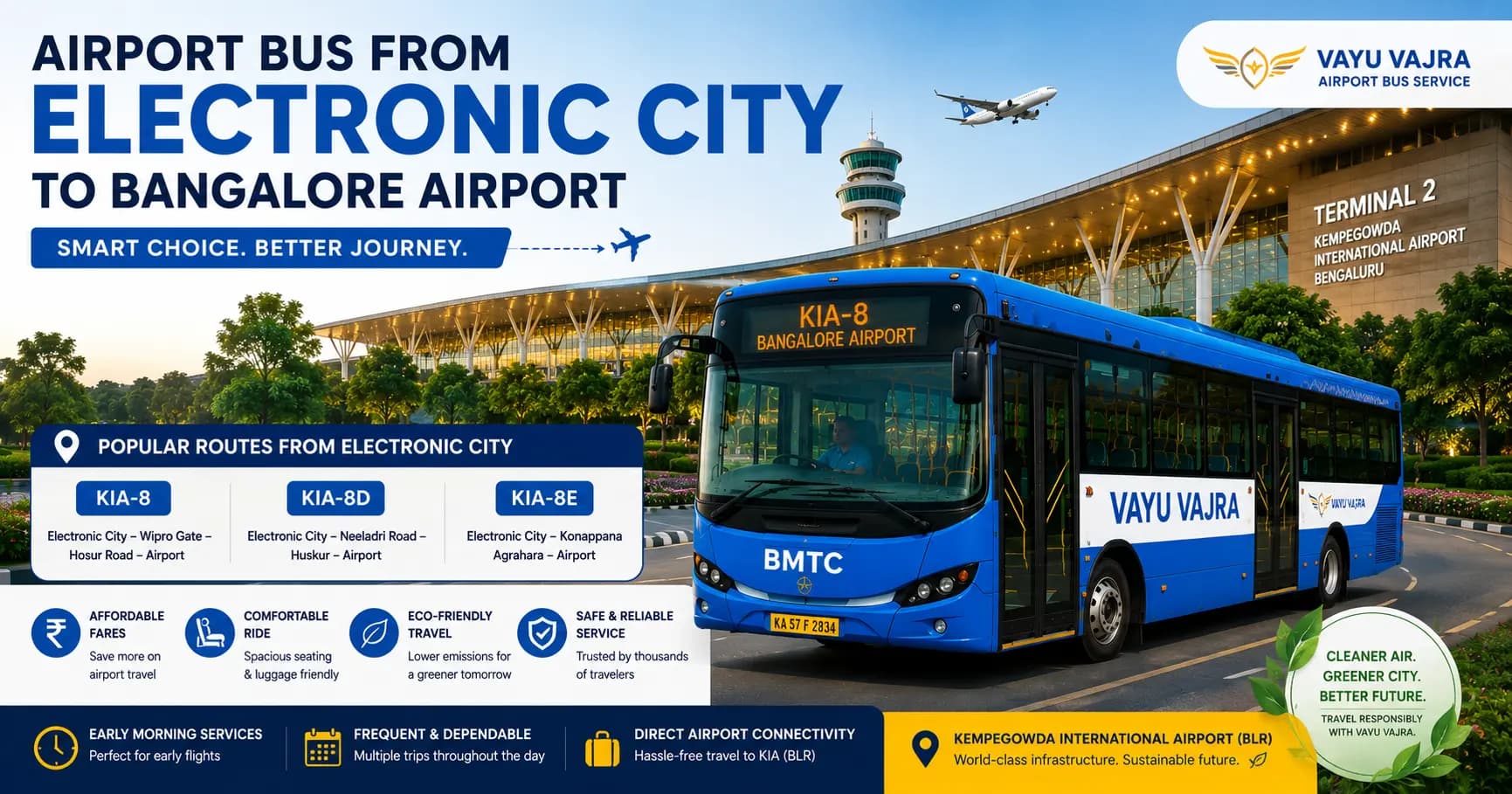
Airport Bus from Electronic City to Bangalore Airport: Complete 2026 Guide
For corporate professionals, software engineers, and residents living in the sprawling technology hub of Southern Bengaluru, commuting to Kempegowda International Airport (BLR) presents a formidable logistical challenge. Spanning a massive distance of over 65 kilometers from Electronic City to Devanahalli, this cross-city transit route is highly vulnerable to severe, unpredictable bottlenecks along Hosur Road, Silk Board, and the Outer Ring Road (ORR).
While relying on private app-based ride-hailing services often leaves commuters exposed to high midnight surge rates and unexpected driver cancellations , the Bangalore Metropolitan Transport Corporation (BMTC) provides a reliable, stress-free alternative. The dedicated Vayu Vajra premium AC Volvo airport bus fleet operates high-frequency, 24/7 trunk lines that bridge the gap between Electronic City and the airport terminal entry gates.
This expert-curated guide covers exact timetables, route variations, boarding hubs, intermediate stops, precise fare matrices, and the critical time-buffer formulas required for a seamless journey.
The primary BMTC Vayu Vajra airport buses serving Southern Bengaluru are the KIA-8, KIA-8C, and KIA-8E routes. Operating continuously 24/7, these premium AC Volvo services depart from major local staging points including Electronic City Phase 1 (Wipro Gate), Electronic City Toll Gate, and Chandapura.
The standard adult ticket fare is ₹390 from Electronic City Phase 1 and ₹410 from Chandapura , with no extra fees for stowed luggage. Onboard transactions are securely processed via dynamic UPI QR codes, cash, and National Common Mobility Cards (NCMC).
Electronic City Vayu Vajra Route Matrix
To prevent confusion regarding which specific route passes through your residential layout or tech park sector, review this precise breakdown of the primary Southern transit pipelines:
Primary Route | Major Boarding Hub & Location | Primary Via Stops & Major Landmarks | Standard Adult Fare | Average Commute Window |
KIA-8 | Electronic City Phase 1 (Wipro Gate) | Phase 2, Toll Gate, Hosa Road, Bommanahalli, Silk Board, Agara, Marathahalli, Hebbal | ₹390 | 110 – 140 mins |
KIA-8C | Chandapura Bus Stand | Narayana Hrudayalaya, Electronic City Toll Gate, Silk Board, Bellandur, Hebbal | ₹410 | 130 – 160 mins |
KIA-8E | Electronic City Phase 1 (Wipro Gate Depot) | Central Silk Board, Marathahalli, Tin Factory, Hennur, Bagaluru | ₹380 | 120 – 140 mins |
Navigating the Staging Areas: Where Exactly to Board
Electronic City is structurally vast, bisected by the elevated Hosur Road expressway. Understanding exactly where your bus stops can mean the difference between a smooth boarding experience and a missed connection.
1. Electronic City Phase 1 (Wipro Gate Hub)
The KIA-8 originates inside the heart of Phase 1. It acts as the primary anchor for corporate commuters exiting major tech campuses.
Key Boarding Points: Wipro Gate Terminal, InfoSys Campus stop, Central Concepts, and the Phase 1 Bus Station.
Otterra Hotel Stop: Passengers waiting for services in Phase 1 often use the bus stop located near the entrance gate of the Otterra Hotel, adjacent to Velankani Tech Park. This municipal shelter, situated approximately 75 to 100 meters before the Infosys bus yard, features vending machines and seating benches. The location is well-lit, benefits from regular arterial traffic, and is monitored by both corporate security staff and patrolling vehicles from the Central Industrial Security Force (CISF).
2. The Electronic City Toll Gate Intersection (The Flyover Catch)
The Toll Gate is the most critical checkpoint for airport commuters in South Bangalore.
The Elevated Flyover Split: It is vital to know that certain late-night or express Vayu Vajra fleets bypass the lower ground-level service lanes entirely to avoid ground traffic. If you stand at the bottom of the flyover, you might watch your bus glide past high above you.
Where to Wait: For buses taking the lower road, use the dedicated BMTC shelter adjacent to the Toll Gate structure. For express services taking the elevated highway, commuters must utilize the staircase or elevator structures to access the designated elevated platform bay before the bus ascends the ramp.
3. The 2026 Metro Integration (Yellow Line Interface)
Following multi-modal transit updates, the Vayu Vajra network perfectly mirrors the infrastructure of the Namma Metro Yellow Line. Commuters can step off the train at the Electronic City Metro Station or Silk Board Interchange and find clearly marked, sheltered BMTC transit bays directly aligned with the metro concourse exits, eliminating the need to take short auto-rickshaws to a bus stop.
The Traffic Strategy: Real-World Time Buffer Formula
Traveling from the southernmost industrial fringe to the northernmost airport boundary means crossing the entire metropolitan landscape. While midnight runs encounter clear highway lanes, daytime trips must navigate two of the most volatile traffic nodes in Asia: Central Silk Board and the Marathahalli Outer Ring Road corridor.
To accurately calculate your departure, utilize this strict operational matrix based on flight parameters:
Flight Departure Window | Recommended E-City Boarding Window | Target Airport Terminal Entry | Risk Profile & Transit Conditions |
05:30 AM – 08:00 AM (Domestic) | 02:00 AM – 03:15 AM | 2 Hours Prior to Flight | Low Traffic: Open roads; bus hits its minimum transit velocity (~90 mins). |
09:00 AM – 12:00 PM (Domestic) | 05:00 AM – 06:15 AM | 2 Hours Prior to Flight | Medium Traffic: Early peak buildup at Silk Board; add a 20-minute buffer. |
02:00 PM – 06:00 PM (International) | 09:30 AM – 11:00 AM | 3 Hours Prior to Flight | High Traffic: Mid-day freight movement and corporate workspace traffic. |
08:30 PM – 11:30 PM (Domestic) | 04:30 PM – 06:00 PM | 2 Hours Prior to Flight | Extreme Traffic: Peak evening logging along the ORR; add a 45-minute buffer. |
The 24/7 Continuity Advantage: Master Timetables
Unlike Eastern or Western suburban sectors that suffer from localized frequency drops past midnight, the Electronic City KIA-8 pipeline operates on a true, continuous 24/7 schedule. Between 12:00 AM and 4:30 AM, departures scale down to a predictable hourly frequency. This eliminates the anxiety of midnight taxi availability; you simply monitor the live vehicle positioning on the official BMTC partner app (Chalo App or Namma BMTC app) and walk to the stop.
Master Departures from Electronic City to Airport
Late Night & Pre-Dawn: 02:40 AM , 03:30 AM , 03:55 AM , 05:10 AM , 05:20 AM , 06:00 AM
Morning Rush: 06:10 AM , 06:20 AM , 06:40 AM , 06:50 AM , 07:25 AM , 08:10 AM , 08:20 AM , 08:50 AM , 09:20 AM , 10:00 AM , 10:20 AM , 11:00 AM , 11:30 AM
Mid-Day Log: 12:00 PM , 12:15 PM , 12:30 PM , 13:00 PM , 13:20 PM , 13:50 PM , 14:20 PM , 14:30 PM , 15:00 PM , 15:30 PM , 16:00 PM
Evening Peak: 16:20 PM , 16:50 PM , 17:30 PM , 18:00 PM , 18:20 PM , 18:30 PM , 18:50 PM , 19:20 PM , 19:40 PM , 19:50 PM , 20:00 PM
Night Runs: 20:20 PM , 21:30 PM , 22:10 PM , 22:30 PM , 22:40 PM , 22:50 PM , 23:10 PM , 23:40 PM , 23:55 PM
Master Departures from Airport to Electronic City
Overnight Logs: 00:00 AM , 01:00 AM , 01:20 AM , 01:30 AM , 01:40 AM , 02:00 AM , 02:30 AM
Early Morning & Day Dispatches: 03:00 AM , 03:10 AM , 03:40 AM , 05:10 AM , 05:40 AM , 05:50 AM , 06:00 AM , 06:30 AM , 06:40 AM , 07:10 AM , 07:20 AM , 08:10 AM , 08:30 AM , 09:00 AM
Onboard Payment & Transaction Protocols
BMTC has completely integrated high-speed Electronic Ticketing Machines (ETMs) across its premium Volvo fleet to handle contact-free transactions directly from your seat:
Dynamic UPI QR Codes: The bus conductor types your destination into the ETM, which projects a unique, dynamic QR code on its digital screen. You can scan this using Google Pay, PhonePe, or Paytm for immediate verification.
National Common Mobility Cards (NCMC): Open-loop transit smart cards issued by Namma Metro or major national banks can be tapped directly against the conductor’s terminal for seamless contactless deduction. The offline transaction processing flow is designed for rapid verification even in network dead zones:
$$\text{ETM Reader Tap} \longrightarrow \text{Offline Chip Ledger Verification (Max Balance ₹2,000)} [cite: 266] \longrightarrow \text{Instant Ticket Generation}$$
Physical Currency: Traditional paper cash is fully accepted.
⚠️ Failsafe Commuter Pro-Tip: Always preserve a ₹400 cash backup inside your wallet when traveling between 1:00 AM and 3:30 AM. Core Indian retail banking networks and UPI merchant payment gateways frequently cycle through scheduled automated maintenance scripts during these exact midnight hours, causing wireless digital transactions to time out unexpectedly onboard.
Financial Math: Vayu Vajra vs. Cab Surge Analytics
Evaluating a solo or small-group commute from Electronic City highlights why the bus consistently outperforms app-based ride aggregators:
The Solo Commuter Math: A standard ticket on the KIA-8 from Phase 1 costs a flat ₹390. A baseline taxi ride through Uber or Ola from the same tech park starts at an average of ₹1,000 to ₹1,500. During midnight flight windows or sudden downpours, cab algorithms invoke predatory 1.5x to 2.2x surges, driving taxi costs up to ₹1,600 or ₹2,200. Transitioning to the bus saves a single passenger up to ₹1,810 per direction.
The Toll Inclusion Factor: Taxis routinely exclude the elevated highway toll fees from their upfront app quotes, resulting in frustrating post-ride billing adjustments or arguments with drivers onboard. Conversely, your Vayu Vajra ticket price legally includes all highway toll charges, eliminating out-of-pocket friction.
Luggage Hold Capabilities: Cabs operating in Southern Bangalore frequently utilize compressed natural gas (CNG) fuel units. The large gas storage tanks occupy the vast majority of the trunk volume, forcing travelers to awkwardly cram suitcases into the passenger cabin. Vayu Vajra Volvos provide massive, deep underbelly cargo bays where your suitcases are locked away safely for zero extra cost.
Frequently Asked Questions (Electronic City Edition)
Q: Can women travel for free on the airport bus from Electronic City under the Shakti Scheme?
A: No. The Karnataka Government's Shakti Scheme provides free transit privileges strictly for ordinary, non-luxury city and suburban BMTC buses. Because the airport lines are premium luxury AC Volvo fleets, all female passengers must pay standard adult fares.
Q: Exactly where do these buses drop you off or pick you up at Kempegowda Airport?
A: Every Vayu Vajra route drops you off at the centralized Ground Transportation Bay, situated a brief 3-minute walk from the terminal gates. Due to lane constraints at Terminal 1 (T1), buses only halt at the T1 boarding slots for a strict 10-minute window before clearing the bay. If you are boarding after landing, step directly onto your route as soon as it pulls in rather than waiting for it to idle.
Q: What is the cheapest bus fare to Bangalore airport from South Bangalore?
A: While short local hops in northern outer zones like Yelahanka start near ₹100–₹170 , the standard baseline fare for the KIA-8 from Electronic City is ₹390 , while the KIA-8C from Chandapura is ₹410. This flat rate includes all highway toll fees, saving you from taxi receipt inflation.
Q: What app should I use to check real-time bus arrivals in Electronic City?
A: You can comfortably track live bus locations, routes, and timetables using the official Namma BMTC app or Chalo App.
Final Transit Checklist for South Bangalore Commuters
Before you step out the door for your next flight, ensure you check off these vital operational steps:
[ ] Verify Live Bus Locations: Open the app at least 20 minutes before departure to ensure you catch the incoming vehicle instead of relying on static, generic timetables.
[ ] Locate the Elevated vs. Lower Split: Confirm if your chosen boarding window requires waiting at the upper elevated toll platform or the lower ground-level highway shelter.
[ ] Secure Hard Cash: Ensure you have physical bills matching your exact fare bracket to handle late-night UPI server blackouts.
[ ] Confirm Terminal Requirements: Know if your airline arrives at Terminal 1 or Terminal 2, and remember that buses at the airport transportation bay observe strict 10-minute departure windows.